Suzie Baker OPA – Board Member – Past President

Ferdinand Hodler, The Disappointed Souls, 1892, 120x299cm, Guggenheim Museum, New York – Public Domain, Wikimedia Commons
Names and offending images have been omitted to protect the not-so-innocent.
Oh, the cheaters we’ve seen over the years…this painting by Ferdinand Hodler illustrates so well the feeling we on the OPA Board have every time we have to address a fresh incident of cheating.
From the outset, let’s be clear: this article is not intended as a sensational exposé. Rather, it is an acknowledgment that Oil Painters of America, like any organization committed to excellence, occasionally encounters rule violations—and that we take seriously our responsibility to address them.
Across more than three decades as an organization and hundreds of exhibitions and online shows, OPA has found that such incidents are rare, but persistent—perhaps a handful a year. Addressing them thoughtfully and consistently allows us to maintain the integrity, fairness, and high standards that our members and exhibiting artists expect.
Sometimes Rule Violations Are Unintentional
We recognize that not all rule violations are intentional. Mistakes are made. OPA’s submission rules are detailed, and artists sometimes assume they understand them without reviewing the prospectus upon entering.
We strongly encourage all artists entering OPA exhibitions to carefully review our submission rules:
Questions are always welcome. Our knowledgeable staff regularly assists artists who want clarification before entering. For example, members often ask whether paintings created in non-instructional portrait or figure groups qualify as original concept and design and are eligible for entry. (They are!) Reaching out beforehand allows artists to enter with confidence and peace of mind.
When Rules Must Be Clarified
As technology evolves, so must our policies. Occasionally, new situations require clearer language or additional guidance.
Most of us have encountered product warnings that seem obvious—until we remember that they exist because someone, somewhere, tried something ill-advised. On irons: “Do not iron clothes while wearing them” On strollers: “Remove child before folding” On sun shields: “Do not drive with sun shield in place.”
In much the same way, OPA periodically updates or clarifies its rules to address misunderstandings, questionable practices, and most recently, clarifications regarding the use of artificial intelligence (AI).
While these updates can feel tedious, they serve an important purpose: protecting artists who work honestly and ensuring a level playing field for everyone. OPA’s mission remains unchanged—to uphold excellence in representational oil painting
The OPA Rules & Bylaws
This recently clarified section of the OPA Rules and Bylaws now reads:
“Only original paintings are acceptable for entry into OPA Exhibitions. They must be created by hand solely by the artist submitting the painting and be original in concept and design. Grounds for disqualification of a painting include the following:
A. Use of Artificial Intelligence to generate a design or create the facsimile of a painting.
B. Copying from photos or images that were not created by the artist, including stock images, historic photos, or of any reference to which the artist does not hold total copyright. Purchased reference material that transfers copyright to the artist is unacceptable.
C. Use of digital, photo, or other mechanical transference to the substrate of an image. The artist must draw and/or paint the image on the substrate themselves.
D. Entry of a painting created in a paid instructional setting such as a workshop or art class.
E. Entry of an image of a painting that does not represent the artist’s final and completed artwork.”
Find the full prospectus for the Thirty-fifth Annual National Juried Exhibition of Traditional Oils here.
Interested in a deeper dive into the OPA Mission, Policies, and Bylaws? Pour yourself a warm drink, get comfy, and find them here.
Sometimes Cheaters are Intentional
Here is a list of the most common infractions we have encountered over the years. (If any of these elicit a strong reaction, know that the Board and staff share it.)
1. Printed Images Presented as Paintings
On rare occasions, photographic or digital images are printed on canvas and enhanced with paint. These works are typically identified during installation by museum or gallery staff or by a Board member prior to an opening and are removed from the exhibition.
2. Digitally Created Work Submitted as Oil Painting
With the growth of digital tools and AI, this issue has become more common. OPA addresses this through juror education, detection software, and a secondary review of accepted works.
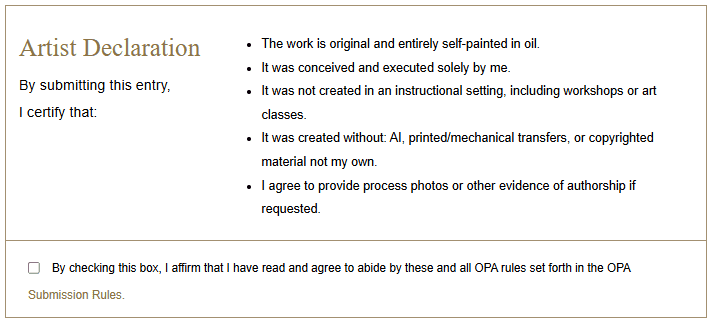
While some organizations are looking to require each submission to include a “work-in-progress” image to accompany each entry, we have decided this is too burdensome to institute for the vast number of honorable entrants. Instead, moving forward, when artists enter their images, they are required to check a box affirming their compliance with our rules, and their willingness to provide us with process photos or other evidence of authorship if it is requested.
3. Copies of Other Artists’ Work
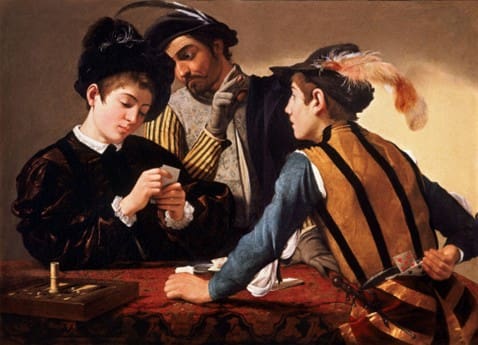
Master copies and close study of influential artists have long been an important part of artistic training. Recreating a painting for educational purposes can be invaluable in developing skills and visual understanding.
However, work submitted to OPA exhibitions must be the original concept and design of the submitting artist. Inspiration differs fundamentally from replication. From time to time, OPA encounters paintings that closely mirror an existing work by another artist. This may include work that is substantially similar, paintings that appear to be reversed versions of known works, or replicates another work too closely to be considered original.
4. Use of Copyrighted Reference Material
OPA has encountered works based on identifiable copyrighted characters or images. As our rules state, references must be wholly owned by the artist; purchased or licensed materials are not acceptable.
How Cheaters Are Typically Discovered
● Tip-offs (anonymous or otherwise)
The number one way cheaters are caught? Other artists. Creating an excellent oil painting takes effort, and when artists see someone trying to cut corners, they speak up.
● Direct observation
Every painting is viewed by a juror (or five) and a judge. Physical paintings get shipped to shows and are handled by museum or gallery staff. Attending Board members are often the first to peruse a show. Every link in that chain is an opportunity to check the authenticity of a piece.
● Detection Software
Entries are subject to AI detection software. If an entry is questionable, or is due for an award, it will be given extra scrutiny.
● Communication Between Organizations
OPA communicates with the leaders of other arts organizations. It’s really a small world in that regard. If applicable, when someone gets caught by one group, the others are quietly notified in the interest of our shared standards. A note here: to date, it is not our practice to publicly name names. We hope to keep it that way.
The Consequences
When a concern is substantiated, OPA follows a formal review process. If a piece is found questionable, the artist is notified and given the opportunity to provide clarification or documentation.
These situations are handled with discretion and care. Consequences may include removal from exhibitions, revocation of awards, and changes in membership status, in accordance with OPA policies.
Recent bylaw updates (listed below) now allow for stronger responses in cases involving knowing and flagrant violations, ensuring fairness for the broader membership.
“II. An artist who submits an entry in contravention of these requirements is subject to disqualification from exhibiting in any OPA exhibition for two years.
III. The Board of Directors shall have the authority, by a vote of no less than two-thirds (2/3) of the Board, to terminate the membership of any individual whose actions, submissions, or representations are found to be in flagrant or willful violation of these rules or whose conduct is deemed contrary to the aims and integrity of Oil Painters of America. Grounds for such action include, but are not limited to:
A. Submission of artwork that is misrepresented as an original oil painting, including works partially or wholly generated by artificial intelligence or digital manipulation.
B. Repeated or deliberate violations of OPA’s exhibition rules or ethical standards.
C. Conduct that undermines the reputation or mission of the organization.
Prior to removal, the member shall be notified in writing of the alleged violation and given a 30-day window of opportunity to respond. The Board’s decision shall be final. Such expulsion will result in forfeiture of membership dues, competition entry fees, any award related to the misrepresentation and revocation of any OPA and OPAM Signature designations. If applicable, the painting will be mailed back at the artist’s expense.”
Upholding Our Standards—Together
Oil Painters of America exists to champion excellence in representational oil painting. We believe artists are best served when the standards are clear, consistently applied, and fairly enforced.
If something in an exhibition gives pause, we welcome thoughtful communication. Occasionally, what appears questionable is simply the result of extraordinary skill and dedication. Other times, it brings an important issue to our attention.
We are better together.
Tom Watson says
Long before the computer and AI, some fine artists and illustrators often shortcut their process of developing a painting or drawing, by projecting a photo onto the surface they intended to do the finished art and drawing the outline. Granted it is a time saver for illustrators under a tight deadline or a low budget job, but it also can be a crutch for those with weak drawing skills. For those that have developed their skills thru miles of study and practice, they deserve to compete only with other painters who have had a similar development of their skills. Same scenario for those that piggyback on other’s talents by copying photos taken by skilled photographers, stealing their concept, subject and composition. At least half of the painting is done by someone else. It’s called “plagiarism,” and it’s the difference between the hobbyist and skilled professional.
Victoria Coe says
Excellent article. I often wondered how OPA handled this potential cheating. I wonder if printed/mechanical transfers is the most frequent.
I was also glad to see the Ferdinand Holder — he is among my favorites.
Suzie Baker says
Agreed! His flesh tones on this piece!!!
This painting made me really laugh when I found it. That could be the guys on our board, Jeremy, Kurt, Rich, Bill ….
Beth Barger says
A thoughtful and much-needed explanation of how OPA leadership is addressing a complex issue. This conversation is happening in local art organizations too, and many look to OPA for guidance.
I don’t paint for accolades, but I do submit to juried shows as a way to measure growth. Rejection is part of that, and I accept it—along with the reality that jurors bring different perspectives and inevitable human bias.
What’s harder to accept is when accepted work doesn’t align with the prospectus—whether it’s workshop-derived, copied from non-original references, overly derivative, or AI-generated. That undermines a level playing field and distorts the benchmarks artists use to assess their progress.
Thank you to OPA leadership for addressing this thoughtfully and for the steps being taken to mitigate these concerns.
Jill Stefani Wagner says
I agree completely with OPA’s diligence in keeping their exhibit entries “honest.” I only wish that the same care would be taken at plein air festivals. I’ve seen many artists flaunt the rules, even established, well known artists…. 😕
Nicole Kennedy says
I appreciate this article. I think the language “created” in a workshop is where I see some artists believe the rule doesn’t apply to them. They bring works in progress and their own reference to a paid workshop and continue the piece throughout claiming the instructor didn’t guide them much. I’ve tried the argument that the instructor might have made a subtle “value or color” comment that the artist would never have considered before. Or they do a 1/4 start and finish at home on their own. My perspective is if you set foot in an instructional setting it’s going to influence any mark you make while there. Not everyone sees it this way. Maybe the language can be adjusted to “created or worked on at any stage ” in an instructional paid setting. Just a thought.
Susan Hecht says
Well said!
Robert J. Simone says
Well done, Suzie! Thanks for taking the time to write and publish this article. And many thanks to the board for upholding these standards and protecting the integrity of the fine art of oil painting. We all encounter students and/or other artists who are looking for a technical advantage that circumvents the purpose and spirit of fine art. It’s okay if that’s what they want to do. But don’t pass the product off as original, hand painted artwork. So proud of OPA for taking this stance!
Susan Ploughe says
Thanks for upholding standards. Could you further clarify Rules and Bylaws item B? Suppose I conceive of, say, a painting based on photos I took in Guatemala, and for symbolic or story-telling purposes, I want to include an image of their national bird. I never got to see one on my trips there, so the only way I could do so is to use other people’s photos as reference. The pose, the lighting, the environment, etc., have been designed by me; the photo provides information about the bird that I don’t possess. Acceptable or not?
Suzie Baker says
Technically, the photo references need to be your own.
I suppose an argument could be made that it is original if an artist has diverged so much from the source material that it was practically like painting from your imagination or knowledge of the subject.
When an artist is interesting in submitting something that they feel might have something questionable in it, they can contact our staff and we can consider the unique situation. Honestly, it’s very difficult to make rules that unambiguously address every situation.
By contacting us with specific request, we at OPA are able to consider the spirit of the law and not just the letter of the law.
JOHN BUXTON says
I have judged several art competitions and have often stated … I have no way of telling from a digital image on my computer ,of the entry , if there has been any type of manipulation ,advanced help or having been copied from another artist ( unless obviously copied from something well known )
I have never tried AI ; nor have I ever used some computer program to aid my drawing or composition . Therefore , since I am not versed in such … how would I know what to look for ?
As mentioned , once a painting is delivered to a show and seen … it becomes clear that something is amiss . But what about online shows ? Is there any way to detect these situations ? I know that in some cases it is possible to greatly enlarge a submitted entry, but I believe there is a size limit to its enlargement ( there was a limit in one show that I judged & it didn’t help me)
Obvious answer : don’t judge shows John … just paint … & trust that the percentage of cheaters remains low .
Yvonne Todd says
Excellent article that fully explains the OPA position on cheating. Thank you for clarifying the use of others photos and AI.
Kasandra McNeil says
Thank you, Suzy, for this thoughtful article. I appreciate the extra steps OPA is taking to ensure the standards of excellence remain high.