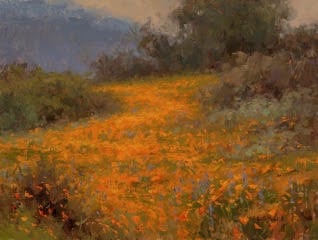
Recently, I was asked during an interview, why it is I paint. This certainly is not the first time I’ve been asked this question and I’m sure it won’t be the last. Throughout various stages of this painting journey my answer might have been something like, ‘to study light and color’, to study the atmosphere, to be with one with nature, to continue growing as an artist, and so on. Although each of those remains true, I noticed my usual answers had quietly shifted into the background…
As painters we seem to be in a constant state of growth, so we hope anyway. I remember when the saying, ‘the more you know – the more you know you don’t know’ seemed to be about the truest thing. It was profound, freeing, and exciting all at the same time. I just love those little epiphany nuggets. It was one of the things that kept me coming back for more day after day. This too remains true, but that has also begun to shift into the background and quieted itself like a lingering truth that just is, freeing up space for the next layer of what might be. Today, I find freedom in ‘not knowing’. In fact, I embrace the not knowing, allowing more freedom in my work. Space for my efforts on canvas to be much less precious, to allow for my childlike curiosity to explore, to listen, to try things, and to begin a painting with ‘I wonder. . .’ The years of hard work and studying the fundamentals have become but an instrument to say something. And don’t get me wrong, I am still working on improving my fundamental skills every day.
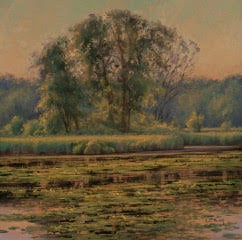
When I teach a workshop, the first morning I gather my students and ask them to introduce themselves and to share one intention they have for our time together. It fascinates me that throughout the years of teaching, the most common desire I hear from painters is to ‘improve their brushwork’. They may say something like ‘loosen up’ or ‘find their style,’ ‘improve brushwork’, ‘be more painterly’, ‘bolder,’ etc. And for years I’ve been telling them the way to improve their brushwork is by improving their knowledge of color, allowing confidence to effortlessly come through the brush. This is HOW to do this, but what’s become more interesting, is WHY do we desire this?
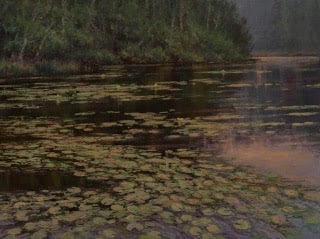
Is this really what they are desiring? Or is it possibly that we lack words to articulate what it is we want to express with paint? With so many artists sharing this common thing, it can’t be a fluke thing; it must be a human thing, a deep-down desire to say something, to express the way we FEEL. Painting is a language. We use language to say something, express, articulate, communicate, connect. And along with this surface’s authenticity, truth.
I teach the fundamentals of representational painting with an emphasis on color. I do this because I too know the longing for having something to say and lacking the tools – the means of expression to do so. The fundamentals of drawing, values, color, composition are all but tools, our instrument to make music with paint. This is where freedom lies and where we can find our true voice and continue discovering it. I’ve found that you can’t find your voice, it shows up when we show up, authentically, curiously, doing the work.
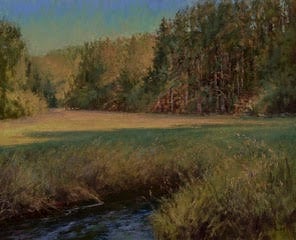
So why do I paint? I guess because deep down I have something to say, and painting is my language.
If you’d like to study and improve the fundamentals, my daughter Paige and I spent the last year creating an online course called “Color Relativity – The Fundamentals”. You can find this course at www.colorrelativity.com and see my work and class roster for 2027 at www.kamimendlik.com
Happy Painting! Kami
Leave a Reply