 I paint with both water-mixable oils and traditional oils, and I get a wide variety of responses when people discover this. Everything from rude negativity (“what crap is that?”) to nods from those in the know (“I use them too, aren’t they great!”). It’s rather funny, as most art supplies don’t have groupies or naysayers like this… The lovers and the haters of water-mixables.
You would think there would be a safe middle ground, but unfortunately, outright suspicion of water-mixable paints (oil and water shouldn’t mix, right?); or rejection of new science as bogus, can make artists retreat to tried-and-true materials. But technological advances have given us: lightfast pigments, more colors, and safer paint than ever before. The old masters would KILL to have our paint choices, I’m sure. So, let’s take another look at water-mixable paints with an open mind.
Water-mixable oils (also known as water-miscible or water-soluble) can be a great asset to oil painters if you know some secrets to get started. I’ve had more than one artist friend confess they tried them, but ‘tossed them all out’ wondering why anyone likes them at all. However, if used correctly, you will see why many artist’s are very excited about these paints.

What’s Not To Love?
Water-mixable oils sound great: artist-grade pigments, easy clean-up, no solvent needed. They also dry faster in general than traditional oils thus great for travel, or under-painting with ‘lean’ layers.
Looking Past the Label: A Little Science Lesson
Yes, they are ‘real’ oils, just like traditionally formulated ones. Water-mixable paints in the tube contain no water, only oil/binder, pigment, and additives such as resin or emulsifiers. The big factor for most people is understanding how this ‘oil and water’ idea even can work. However, there is solid science behind the paint which has been around since 1990. Different brands of paint use different elements to allow the oil and water to mix. Either a fatty acid molecule in the oil has been modified or removed to allow for binding with water, or an emulsifier has been added. Sometimes it’s a mix of factors. This is not necessarily a scary thing or ‘too new’ to use without question (like genetically altered food); oil and water have been mixed for centuries to make creamy things like mayonnaise, or tempera paint, with egg as an emulsifier. Also, we must remember that artists for centuries have been experimenting with new ways to paint. Someone invented oil painting in the 15th century after all… It was not always around.
Benefits Of Water-Mixables:
Better For Your Health, as there is no need for solvent. Simply use water as your ‘solvent’ to thin the water-mixable paints and for clean up. You can tone your canvas, wipe areas out, or create a ‘watercolor’ thin under painting. Solvents are not healthy as all have a warning label, including so-called ‘green’ ones. Newer OMS solvents (Odorless Mineral Spirits) such as Gamesol still gass off harmful vapors, you just can’t smell them, unlike turpentine which has a powerful smell. Allergies to solvent can develop suddenly or gradually over time. You may not even know you have a sensitivity (this can appear as headache or fatigue; or more severely as hives, light-headedness and shortness of breath). Interestingly, solvent as a paint medium/thinner has not been in use all that long in the history of oil painting… so perhaps we should be taking a look at the archival nature of solvent in oil painting as well? But that’s another blog post I think…
 Faster Dry Time. Water-mixables dry in about half the drying time of traditional oils. The paints actually have two dry times. For thin watery mixes (like a watercolor wash or canvas tone) the water evaporates rapidly and is mostly dry to the light touch in 5-10 minutes. You can still re-wet areas to wipe out or re-mix. At this stage it is possible to start more direct painting, or layering with thicker strokes. To let a thin tone or grisalle layer fully dry (via oxidation) wait at least until the next day. The thicker the paint application (the less water used), the more your dry times will increase. Paint that contains a lot of oil already such as Cadmiums can take longer to dry.
Clean Up Is Very Easy. Just use soap and water. Also great for travel.
Excellent For Layers/OK to Intermix With Other Oils. Because the paints dry quickly if you know you like to layer, you can start your artwork with water-mixable oil paints and then move into more full-paint layers, or on to traditional oils (since the dry time is more with traditional oils they are therefore ‘fatter’). You can inter-mix traditional and the water-mixables if you are painting directly. Once you cross over a 20% ratio (approximately) the water-mixable quality gets lost. You can intermix brands of water-mixable paints. Although manufactures say it’s safe to intermix these paints with other media (watercolor, acrylic, alkyd) I would be cautious here. I believe after researching this paint, that with too much mixed stuff it is hard to control the dry times of the paint layers. The only trouble I ever had with these paints was when I used Alkyd Titanium White and Quick Dry water-mixable gel medium for heavy applications of pastel whites (fine cracks developed after a few years, in a few studies done on panel).
Traditional oil paint still has it’s place, especially for those who like a long time to maneuver wet paint on the canvas. Currently my favorite way to work is to start with water-mixable in one or a few colors, and then switch to traditional oils for the longer dry time. I still paint without any solvent when using traditional oils and use a variety of techniques to get by. I freeze my brushes for the next paint session (used paint is still in the brush). If I need a clean brush I’ll dip it repeatedly in oil to free excess pigment.

Drawbacks Of Water-Mixables:
Avoiding Sticky Paint. If you are not careful with how you use the paints they can become sticky, which is very unpleasant to paint with. Avoid using the paints with a small amount of water, as they don’t thin very well with a few dots of water (to make it more viscous). Instead, a little water-mixable linseed oil or water-mixable medium will work wonders to make the paint more spreadable. Ironically, it’s fine to thin the paints with a lot of water (to make a puddle that looks like milk) to start your drawing or ‘block-in’ stage, grisalle layer, or to tone the canvas. Remember, that this watery layer should only be an under-painting. Layers that are too thin will not stand up to the ravages of time and are not archival. Some paint brands such as Cobra are inherently more creamy right from the tube, thus avoiding the sticky range for the most part.
Paints can freeze more quickly in winter conditions if you paint outside in the winter.
Rain Texture. Paints will not work well in the rain or mist (obviously), although rain can create some interesting texture effects, so this could be a good thing.
Paints can dry with a more matte finish, but a simple varnish layer, or working with a medium or a touch of oil will fix this.
Will These Paints Last?
Remember these are ‘real’ oils (not alkyd or acrylic) and we know oils last for centuries if they are painted on a proper surface with good techniques (‘fat-over-lean,’ etc.) and cared for. Studies so far show these paints to be very archivally sound. I will say that although current and past scientific studies were referenced frequently, (I did talk to a technician who worked in a lab), no manufacture provided me with actual papers or concrete published studies with hard data. So, I’d say more sharing can be done in this arena. On a personal note, I have a painting that was done with Max (Grumbacher) paints on canvas in 1998 that has a paint film in perfect condition with no cracks or color distortion (I keep it to remind me about my early oils). It’s been carted around the country in several moves and stored in less than ideal conditions in the back room or unheated garage.
 Brand Comparison/Reviews of Water-Mixable Paints:
There are several major paint manufacturers of water-mixable oil paints: Grumbacher (Max – nice, great colors, but can be stiff), Holbien (Duo – very nice, a bit more expensive) and Winsor & Newton (Artisan – can be smelly, contains only ‘hue’ colors, and has somewhat less pigment load, also can remain sticky when dry), and Royal Talens (Cobra – newer brand, very nice buttery consistency, yet some colors are ‘off’ such as the too-pale cadmium yellows and a too-strident French Ultramarine). Newer brands have come on the market: such as Weber (sOil), Lukas (Berlin), Daniel Smith, and Reeves, I have not tried these. Each brand seems to have their quirks. I use a mix of MAX, Cobra, and Duo paints.
(For full disclosure I don’t work for any paint manufacture and currently do not have any contract with any company to promote their paints.)
As you can see there is more to explore with water-mixable paints, but they do offer a wealth of choices and opportunity for the artist of today. Perhaps in time these will be the new way to paint with oils, and we will scorn the old days of when people painted with that awful toxic solvent!
Uncategorized
The Gallery Artist Relationship – Q&A with Scott Jones
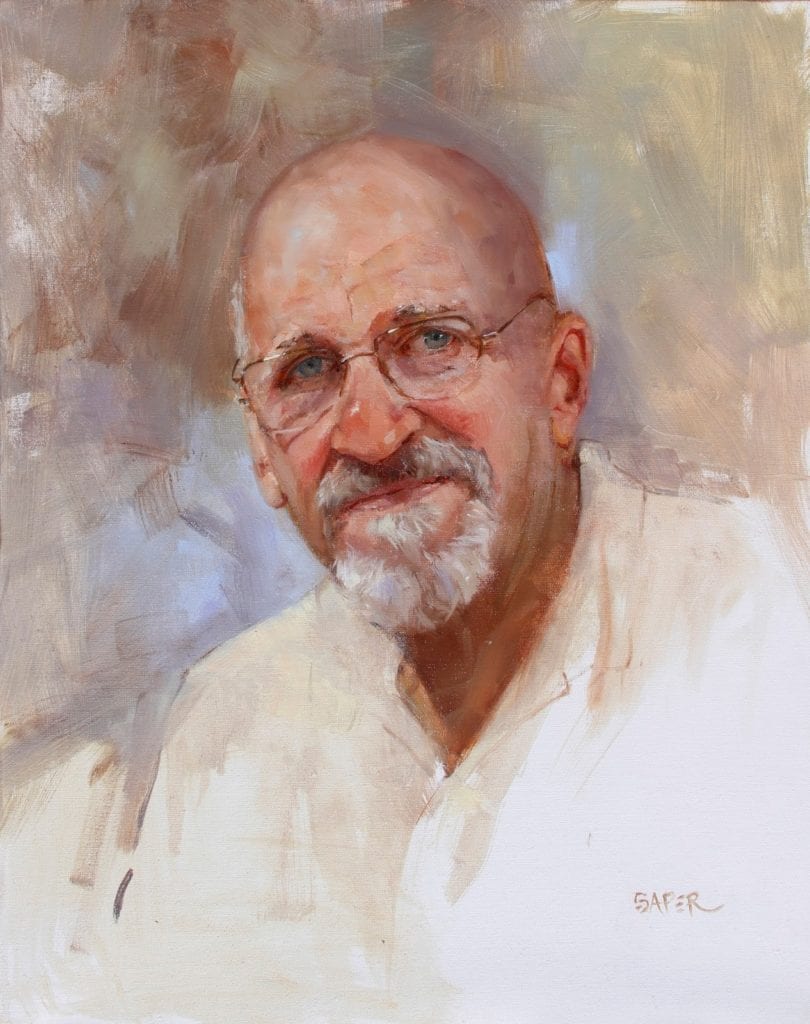
$3,500
20″x16″
Scott Jones serves as the General Manager of Legacy Galleries (Scottsdale, AZ, Jackson, WY and Bozeman MT), among the foremost of representational fine art galleries in the country, shares with OPA members some of his insights into the gallery- artist relationship. Scott spoke on this topic at the Portrait Society of America’s annual conference in Atlanta last April.
CS: Scott, would you talk about how an aspiring artist might be seen by in interested gallery?
SJ: While I can’t speak for other gallery managers or owners, I can tell you a quite a bit about how I find artists and begin to follow them.
The professional, juried shows and competitions held by organizations such as the OPA, American Impressionist Society, California Art Club, Portrait Society of America and others make it very easy for me to see the work of both established and emerging artists, since their members are already focused on high quality representational art. The artwork is fresh and current from a wide variety of artists and usually reflects their better pieces.
I spend a great deal of time reading art magazines and conducting online research in addition to watching museum venues and auctions. I find contests like the Bold Brush, Raymar Art, and the Plein Air Salon, attract scores of solid, top-quality painters in each round of their ongoing competitions. I often think I should send them thank you cards for making so much of my research so easy to come by! I saw the first painting by one of our highly successful artists on a Ducks Unlimited Art Contest webpage
Because the Scottsdale Legacy Gallery is only a few blocks from the Scottsdale Artists School, I like to take regular opportunities to visit the classrooms of instructors, some of whom are represented already by Legacy, or whose work I admire, and on occasion to meet an artist for the first time. Hosting demos in the gallery by workshop instructors has been a favorite activity of mine along with recommending artists to be invited to teach workshops. Visiting the classroom setting gives me a sense of being in the artists’ studios (which I always additionally enjoy!), and a comfortable chance to chat with participants as well. Plein Air events are another rich source for me to see current landscape artists’ work, and to do so in what tend to be lively, informal settings, with lots of spontaneous, engaging interactions.
Our own Scottsdale Salon of Fine Art was intended to create a venue for us and other galleries to discover and establish connections with new artists. I know that we have extended invitations to 2 or 3 artists from each Salon to show their work with the gallery. I was pleased that first year we held the Salon to see over a dozen other Scottsdale galleries come to preview the work and that six of the artists received invitations to show with other Scottsdale galleries. That’s a win/win for everyone. I’ve read a lot of blogs and articles about “juried events” and whether they are worth the expense and time to participate. In my opinion, artists should realistically assess the potential of who will see their artwork in that particular venue if successfully juried in – prospective collectors, other galleries, and other artists.
When I find/see artists who interest me, I’ll put them on my “artist to watch list” which is my own private tickler file of artists including shows, websites and specific pieces. I started this file over 25 years ago and frequently refer back to it and add to and delete from it. And no. I don’t publish it so you may not know if you are anartist I like to follow.
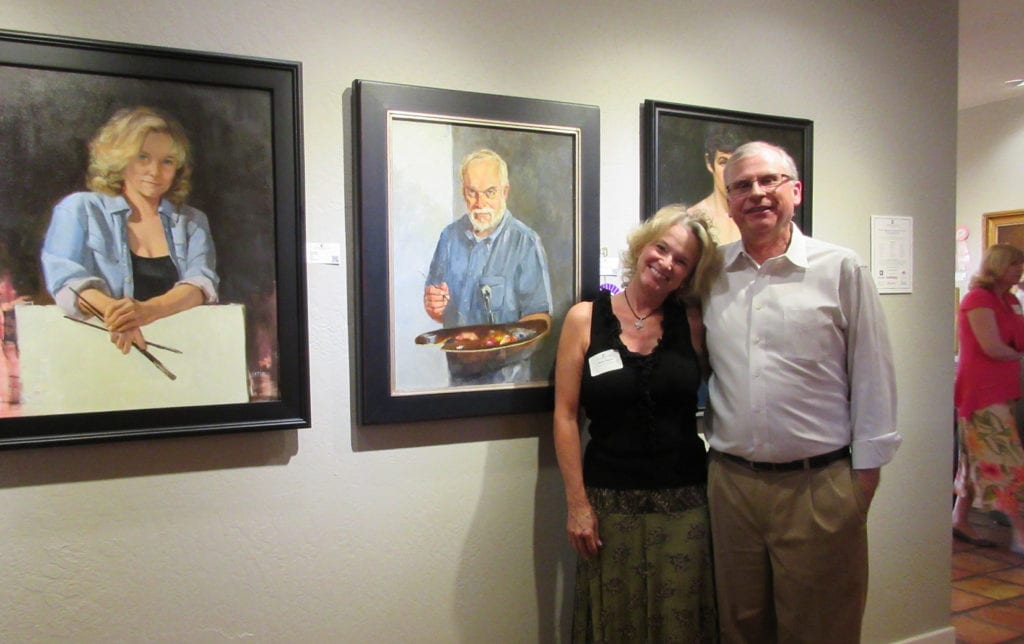
CS: Of course we all think it would be fabulous to actually be sought out by a gallery, but as a practical consideration in running our own businesses, how do we, as artists, most successfully get our work in front of you?
SJ: First, spend the time to investigate whether a particular gallery is a good fit for the type of work you do. And inquire as to what format a particular gallery wants to see – digital images, forms, hard copy, etc.
Never submit your work the same week as a big gallery show – instead maximize the likelihood that the gallery manager is not distracted putting out the multiple fires that can sometimes surround a big opening, attending to last minute details that need attention, that sort of thing. I personally find it difficult when an artist walks into the gallery without an appointment and asks me to look at their paintings. There is some groundwork that can be done first with that gallery.
We can receive more than fifty artist submissions in a month. So an artist really needs to get my attention with about 3-4 images, to entice me to look further – and sometimes even one powerful image can be the key. It all comes down to the art itself. Have your website regularly updated with your most recent artwork because I will look it up. I always find it puzzling that artists will submit images for consideration but not have them updated on their website. Too often the website is outdated and doesn’t reflect what the artist is currently doing.
If I am following you, I will check in often and want to see new pieces and updates on your work. If I check in a couple of times and don’t see anything new, the likelihood that I will do so again drops. If you have a gallery, it helps them if you have your site updated with new works. One other comment about websites that I see debated in blogs. I like to see pricing on websites – both artist websites and gallery websites. As a collector, I like the instantaneous feedback of having pricing available. If I see a piece that interests me, I don’t like to have to email or call for a price and wait for an answer. I also like to follow pricing trends over time. I can’t do that if the information is not readily available. Putting prices on your website reinforces your pricing structure within your galleries.
Let me add a couple of other personal thoughts on websites. I like to see tabs that take me to “current or recent” work and to keep that separate from archived work. An artist’s portfolio will always be judged by its weakest piece, so get rid of any work that doesn’t show you well. I often sign-up for an artist’s newsletter on their website. I will say that I am surprised how many artists rarely or never send out newsletters. I feel that if you are going to offer a newsletter (or promote a blog) that you should send one out every month – at least a photo and quick write-up on a recent piece. If someone takes the time to sign up, they should get regular updates. One of the artists in my personal collection puts out a newsletter on the 1st day of every month. I look forward to it. She never misses. It sets my calendar for me.
CS: We artists are constantly bombarded with social media, our inboxes flooded daily with (often expensive) opportunities for some company or another to “manage our brands” – how important is our individual social media content to you, and do you see this as a growing resource for galleries overall?
SJ: Well, I can promise you I spend a lot of time looking all over the web for information, artists, and work, and social media has become a wonderful venue for me. I follow many artists on Facebook, for example, and you can make my “surfing” easier if you regularly share your news and freshly completed work on your social media platforms. I like to see your studies, your processes and your completed work as well. Have a professional page and invite me to “like” it!
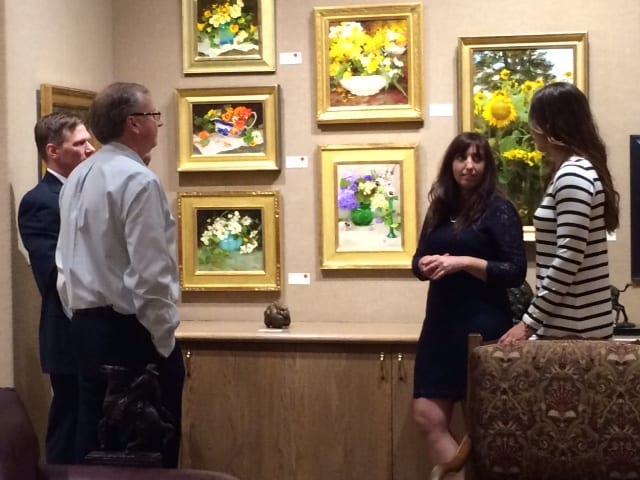 Personally, I have purchased art I saw on Facebook, Etsy and eBay – I saw a drawing last evening on Instagram that I would like to own. One thing I don’t forget is that artists also buy art! Much of our success in selling on social media has been to artists.
Well-considered social media will continue to grow as an important part of the gallery business, the artist business and the collectors’ inquiries. You don’t need to hire a team of PR experts to do a great job of setting up a website, publishing a newsletter, or writing a blog. But, however these things get done, keep in mind that spelling and grammar make a powerful first impression – especially when done poorly. Only put out high quality images – poorly photographed artwork can be worse than none at all. And remember the demographics of the collectors who are buying your work. We continue to mail out catalogs because a large share of our best collectors like to receive them. Gradually they have become more comfortable with email. And now we get them onto our website on a regular basis. It has been a transition. I had one of our best collectors tell me recently that Facebook is only used for keeping up with her grandchildren. They showed her how to use it. She had not thought of the idea of using it to look at art. That will come with time and a little prompting.
CS: There is a long history, if not actual, certainly anecdotal, about galleries going to great lengths to stop artists from competing directly with them. Can you comment on that?
SJ: I ‘m sure there are many such tales out there, quite a few of them true. It is not by accident that I have chosen to work with Legacy Gallery for so many years, because we have a have a deep mutual respect, treating artists well and fairly, and frankly, I like the ethics on both our parts. Our demands are few, and no different from conducting any reputable business: refer viewers to your galleries, and let them know specifically which pieces are consigned to which gallery. Don’t undercut your retail prices. Period. I can relate a story about an artist who decided to sell directly from his website at “wholesale’ prices – that is, the amount that he might typically get after paying a gallery commission. His gallery owner promptly notified the artist (yes, galleries do find out about stuff like this – collectors love to talk about “deals”) that the posted sales prices for all of his work in the gallery would have to be reduced to reflect the new “baseline” retail price he himself created.
Our philosophy is pretty straightforward: we want artist- gallery relationships that work successfully for both parties. We have been established for many years and have worked tirelessly to build our reputation, just as you have. And we plan to be around from many, many years to come. And we don’t need a threatening, ironclad legalese-deluged contract to make that happen; if we aren’t happy, or if you aren’t happy, it’s best to just part ways.
CS: Given the many opportunities for artists to do their own marketing, do you see this as a signal that bricks and mortar galleries will become a thing of the past?
SJ: No. Successful galleries have active marketing functions and strategies. The best galleries add a “retail” presence that goes miles beyond hanging art on a hook and holding an opening reception. You will gain credibility by who you’re “hanging with” – other top quality artists. Galleries can create a sales momentum focused on particular collector demographics, which will already reflect the kind of work that you do. Galleries have access to feature articles and editorials that individual artists may not have. I believe that brick and mortar galleries play an important role in getting people started collecting art. A lot of art is purchased today “sight unseen”, but much of that is from more seasoned collectors who have seen a particular artists work in a gallery setting. Our artists benefit from our galleries being located at the best locations in some great art destinations. We added a third gallery location in Montana because we felt that Montana presented a growing opportunity for our artists and genre of artwork to be seen by potential new collectors. So far, so good!
Our position is that a rising tide floats all boats. When we have a regular advertising presence in national, high quality publications, the artist whose show is highlighted in a given month will add credibility to the gallery, which will be built upon to ultimately showcase the show that features you.
Scott Jones describes himself as passionate “art fanatic”, having purchased his first painting at the age of sixteen, and never really stopping. The former president of Saddleman, Inc. – an automotive accessories company based in Logan, UT, with manufacturing plants in SC, OH, AZ, UT, CA, Mexico, China, and Indonesia, Scott traveled extensively and tied many of his business trips to gallery shows and museum exhibitions.
Scott Jones describes himself as passionate “art fanatic”, having purchased his first painting at the age of sixteen, and never really stopping. The former president of Saddleman, Inc. – an automotive accessories company based in Logan, UT, with manufacturing plants in SC, OH, AZ, UT, CA, Mexico, China, and Indonesia, Scott traveled extensively and tied many of his business trips to gallery shows and museum exhibitions.
“Years ago I told my daughters that they would know I was retired when I was in Jackson Hole selling artwork. That opportunity came much earlier than I expected when my favorite gallery became my employer eight years ago following the sale of our manufacturing companies. How great is that!”
Contact Legacy Gallery here or at any of its three locations:
|
Scottsdale, AZ |
Jackson, WY |
Bozeman, MT |
Or better yet, stop in see for yourself what we do.
Frame Makeover
Refinish those old frames!!
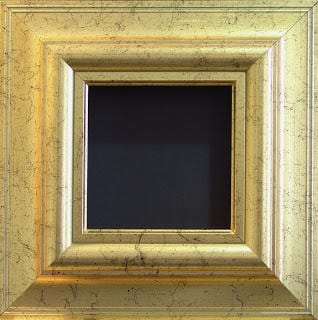
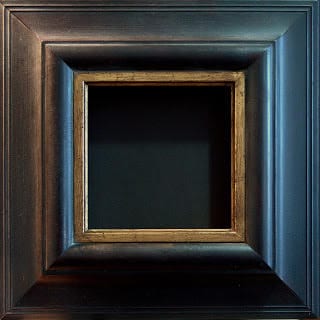
As artists we all seem to accumulate those frames that we just don’t know what to do with. They may have gotten damaged shipping to a gallery or banged around transporting to a show. Maybe they were “ok” frames but the finish just wasn’t up to gallery standards or the color just won’t work with the art.
There are many ways to bring new life back to those old frames so they can come out of the closet and hang proudly on your best art!
I have been a fine art restorer for over 35 years and have learned many tricks about refurbishing damaged frames that I would like to share. Most artists have the ability to refurbish their own frames but they lack the know-how. Being able to modify your own frames can not only save $1000’s of dollars, but it can even open a whole new opportunity to the artist to individualize and modify their frames to be one of a kind pieces that will enhance their art.
I am going to give a step-by-step for you on creating this lovely soft, handrubbed black finish, however, these same steps can be used to modify an existing finish or work with other base colors than just black…..have fun, get creative!
A friend and wonderful artist, Connie Kuhnle, has used some beautiful soft, greyed colors for her charming plein air landscapes. One of my favorites is her antiqued mustard/yellow on a white and yellow farmhouse…it is perfect!!
I often use antiquing and waxing to add some interest to a newly purchased frame that just doesn’t quite have the richness I am looking for. It is a fairly quick and simple step that can make a remarkable difference.
Frame Makeover
Supply list for warm black antique finish:
1. Black paint- I use semi gloss spray enamel, but any good quality black acrylic/enamel paint will work. You can use a brush-on altho you may find that you have some texture of the brush strokes in the finish. They may not be objectionable, depending on the finish you want.
2. Red paint- (optional)….same as the black. Used to create a red undertone.
3. Fine steel wool
4. Fine 280 grit sandpaper
5. Antiquing stain…..raw umber oil paint will work, as will acrylic. you can also purchase a stain like Minwax in a dark walnut color.
6. Rottenstone
7. Wax/polish for wood ( I like “Bison” Black ebony best)
8. Hammer with a claw side
9. Polyurethane wood finish, semigloss, brush or spray
If an antique white frame is desired you will need white paint in place of the black. This same finish works beautifully with a color as well.
- Lightly sand original finish to cut the gloss a bit and allow for better adhesion of the new paint.
- Pound the frame casually, bouncing the clawside of the hammer over the surface to create even (but not too uniform) scars and indentations if you want a more antique look.
- Spray (or brush on) with red paint (if red undertone is desired). (allow to dry as per instructions on the paint).
- Lightly steel wool
- Spray (or brush on) black enamel. (allow to dry)
- Use sandpaper on edges and across the surface to allow some red to show through and give a “worn” look to the finish. It is going to look best if you have fairly even streaking throughout the frame. If the streaking is not even the frame will look splotchy.
- Apply raw umber antiquing with a wide brush and wipe with a soft rag, paper towel, or cheesecloth to remove some but not all of the antiquing. Allow stain to remain in the crevices as well as the indentations that you made. Allow to dry.
- Spray or brush with polyurethane finish to seal. Allow to dry.
- Apply polishing wax and allow it to dry then buff to a nice handrubbed lustre.
- Dust lightly with rottenstone…especially in crevices and detailing of frame. Buff again.
While the steps may seem time consuming they really are not. It is important to give each of the finish layers time to dry so start to finish will take a couple of days but actual time working on the frame shouldn’t be more than an hour or two. With practice you will find it easier and easier to achieve the results you are after and start adding your own variations to create one of a kind finishes!
Barbara Schilling
Fine Art Impressionist Painter
www.barbaraschilling.com
John Austin Hanna Interview

Winner of the “Donors’ Award of Excellence” at the 2013 Oil Painters of America 22nd National Juried Exhibition, John Austin Hanna discusses his illustration background, his transition to a successful fine art career, and his current work.
Illustration as preparation for the fine arts
John Austin Hanna believes his 20-year commercial illustration career in New York and Dallas prepared him well for what has become a successful career in the fine arts. The Fredericksburg, TX artist enjoyed working with many types of professionals, included among them, Bill Neale, an important Dallas artist and art director who was “largely responsible for me going to New York. Illustration taught me to communicate ideas effectively. Even though those ideas weren’t always mine, decisions had to be made that communicated clearly and creatively those ideas. You really won’t make it if you can’t draw and have a good sense of design”, he said.

Transitioning from illustration to fine art was not that difficult for him. “The kind of painting I do is not that much different. The major difference though is not knowing if anything will sell. At least in illustration I got paid, most of the time, for everything I did.” Hanna seems to have a laid back, relaxed approach to his work. He paints anything and everything he is interested in, and does it well, with little concern whether his style will be unique…and yet, it is. Maybe this lack of concern, the variety of subject matter, and the large quantity of work he has produced has been a contributing factor.
He doesn’t call himself a plein air painter but he does believe painting on location is important because it teaches us to see…to see what things really look like.
Selection of subject and working method
The ideas for his paintings come from things he has observed. “The subject pretty much selects me,” he says, “it’s something that just hits me.” When blocking in a painting, his method is loose and free. Normally, he dives right into a painting with very little preliminary work. He prefers to work out his ideas on the canvas during the block-in phase by moving elements around until he gets what he wants. He is not a slave to any set rules of composition. “I should spend more time attempting to simplify and minimize value masses, for I really admire those who do it well.” Even though he pretty much knows what the completed work will look like, he keeps an open mind, always willing to change direction if it will result in a better work. However, when asked how he knows when a painting is finished, he quipped, “When I’m halfway pleased.”
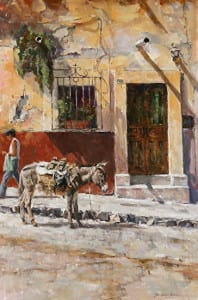
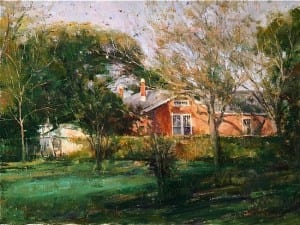
When working from photos he is aware of their distortion and lost details, but he also believes they have value in that they can help the artist to simplify. “The most difficult part of a painting for me is the middle…and putting enough paint on the palette. I do hope however, when all is said and done, that the end result will be paintings that stir feelings of personal importance in others.”
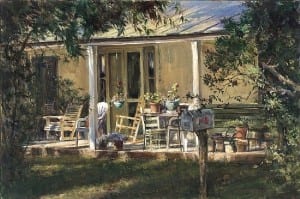
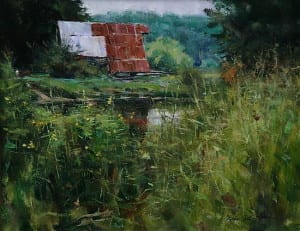
Hanna’s paintings are not “pretty” pictures. They do not romanticize, sanitize, or glamorize the subject. There is a gritty reality to them. When walking through his fields you’ll need boots for you just know those fields could be full of stickers, cockleburs, and grasshoppers. Knock on the door of one of the old houses and you might very easily encounter a crusty old guy with a shotgun.
Art…an enriching experience
Getting Hanna to define art proved difficult. “It’s the age old question. It is what man has done since the beginning of time. A lot of fads come and go. What was considered illustration years ago is now bringing big bucks…as fine art. John Canaday’s book, ‘What is Art?’ is the last and only answer to the question. However, whatever its definition, it is an inexhaustible enrichment for life.” Whatever art is, it is a definite part of the Hanna family. His son and wife own a beautiful little gallery in Fredericksburg called the R.S. Hanna Gallery. They represent some very fine artists, including a nice selection of John Hanna’s work.

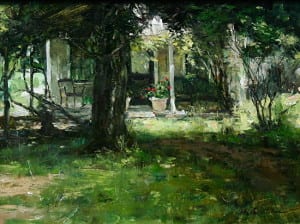
When asked what advice he would give first-time collectors…”Buy original art; read about it, and go see it. Buy what you like; it’s a learning process” To become a successful artist there is only one way: practice, practice, practice, along with perseverance and a lot of luck. He also suggests the young artist/painter should “paint more, talk less; look at everything: galleries, museums, etc…and observe.” Asked which three artists have enriched his life and with whom he would like to spend the day…his answer: Richard Schmid, John Singer Sargent, and Joaquin Sorolla.